

Mesopotamian Artifacts Gallery (page 3)
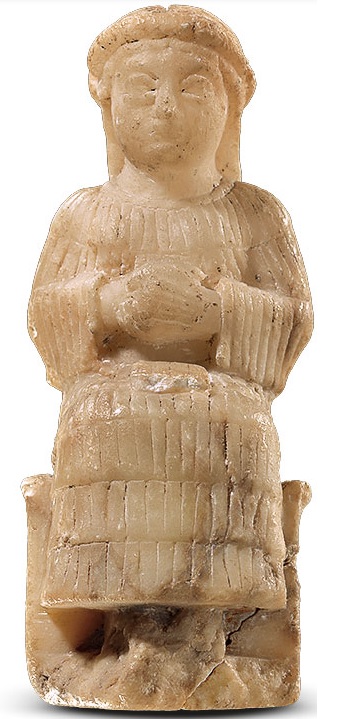
Seated female figure with tablet on lap; Alabaster. Neo-Sumerian, Ur III period (ca. 2112–2004 BC).
©Staatliche Museen Zu Berlin, Vorderasiatisches Museum, Acquired 1913; VA 04854. Staatliche Museen zu Berlin-Vorderasiatisches Museum. Foto: Olaf M. Teßmer.
Most likely representing a high priestess, this statuette calls forth a line from “The Exaltation of Inanna” by Enheduanna: “Me, who once sat triumphant.” The image also resonates with that of Enheduanna on her votive disk. The woman’s transfixed gaze expresses deep reflection and her hands are firmly clasped in devotion. In her lap is a small tablet. Three incisions on its surface represent the columnar division of clay tablets, an overt reference to cuneiform writing. The tablet and divisions bear witness to the dedicator’s well educated status and engagement with writing, perhaps as an author. As a votive, the statue’s offering is a written text.
■ But who is this figure? S. Babcock answers, Iconographical features such as long, loose hair and flounced robe strongly suggest that she was a high priestess, just like Enheduanna. There are three other statues of women with tablets on their laps, all dated slightly later than Enheduanna’s time. It is intriguing to regard these profound visual manifestations of women and literacy as reflecting the longevity of the persona of Enheduanna herself..
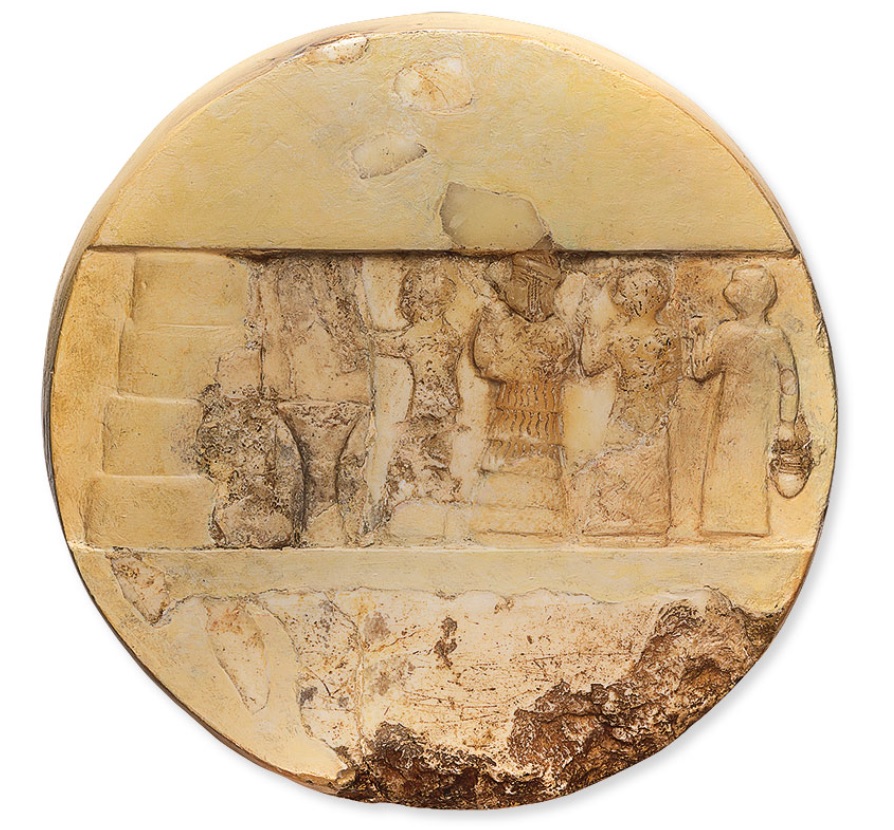
Disk of Enheduanna, daughter of Sargon; Alabaster. Akkadian period, ca. 2300 BC, Ur (modern Tell el-Muqayyar).
Cuneiform inscription in Sumerian: En-h[e]du-ana, zirru priestess, wife of the god Nanna, daughter of Sargon, [king] of the world, in [the temple of the goddess Inan]na-ZA.ZA in [U]r, made a [soc]le (and) named it: ‘dais, table of (the god) An.’
©University of Pennsylvania Museum of Archaeology and Anthropology, Philadelphia, USA, Excavated 1926; B16665
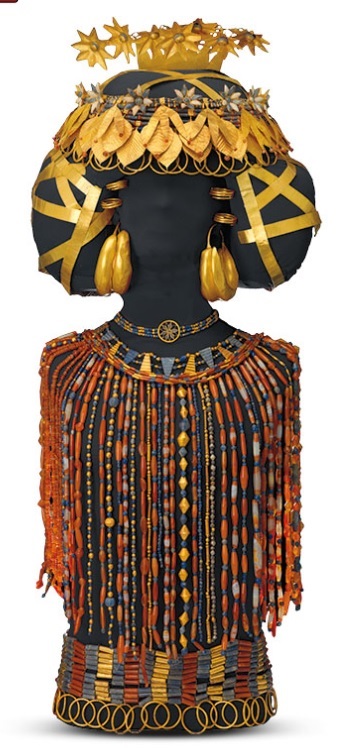
Queen Puabi’s funerary ensemble; Gold, lapis lazuli, carnelian, silver, and agate. Early Dynastic IIIa period, ca. 2500 BC, Sumerian, Ur (modern Tell el-Muqayyar), PG 800, Puabi’s Tomb Chamber, on Puabi’s body.
©University of Pennsylvania Museum of Archaeology and Anthropology, Philadelphia, USA, Excavated 1927/28
These radiant accessories would have formed a halo around Puabi’s face. Below, a choker with a central rosette sat against her neck. A profusion of carnelian, lapis lazuli, and gold beads covered her chest, strung in rhythmic patterns.
Queen Puabi’s funeral in the city of Ur was a meticulously planned event. Her body was dressed in full regalia; her tomb was filled with objects displaying her status and wealth. All carved of exquisite lapis lazuli imported from modern-day Afghanistan, three cylinder seals were carefully attached to three garment pins that secured her cloak. This particular seal was found together with the garment pin.
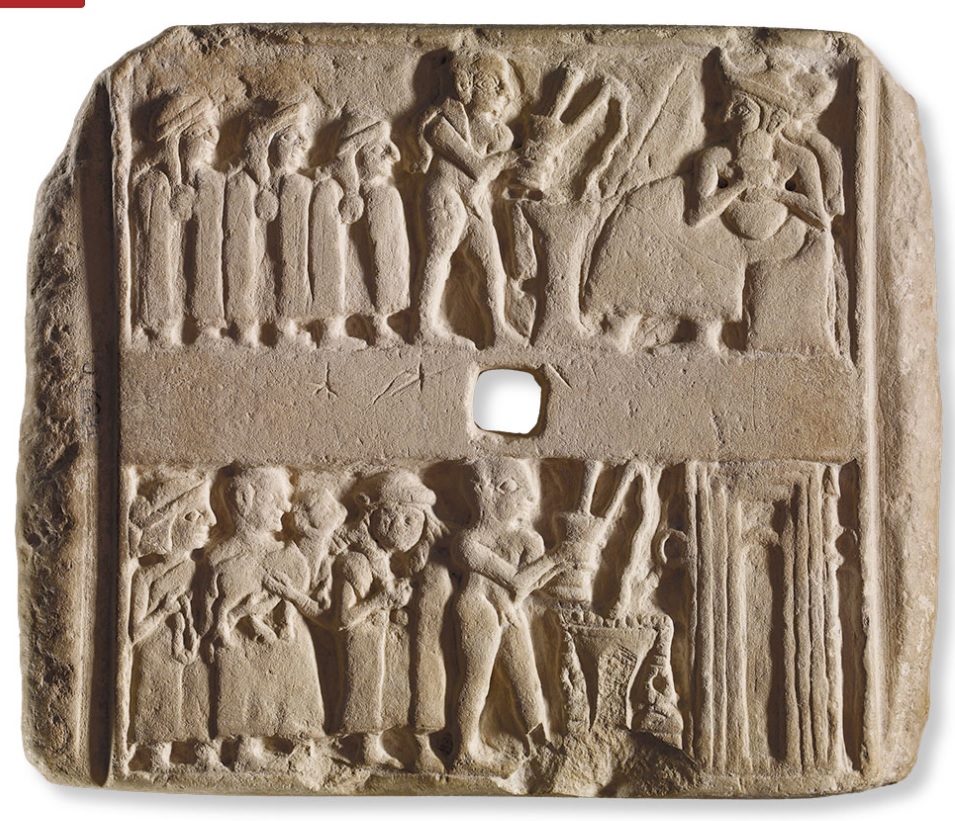
Wall plaque with libation scenes. Sumerian; Limestone. Ur (modern Tell el-Muqayyar), gipar. Early Dynastic IIIa period, ca. 2500 BC.
© The British Museum, London, Excavated 1925/26; BM 118561
This wall plaque was found in the gipar, the residence of the high priestess of the moon god Nanna at Ur.
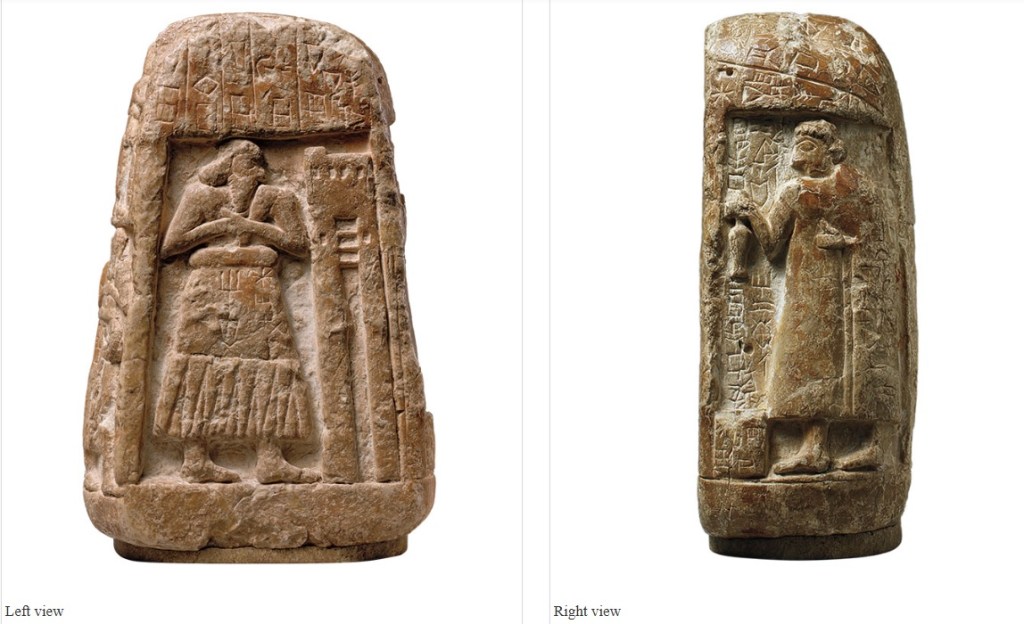
Stele of Shara-igizi-Abzu; Gypsum alabaster. possibly Umma (modern Tell Jokha). Early Dynastic I–II period, ca. 2900–2600 BC. Identifying Shara-igizi-Abzu; her father, Ushumgal; and four other represented figures, including: IGI.RU?.NUN, daughter of Mesi; Ag, chief of the assembly; Nanna, the foreman of the assembly; X.KU.EN, chief herald; Enhegal, the maker of the stele.
© The Metropolitan Museum of Art, New York, 1958; 58.29
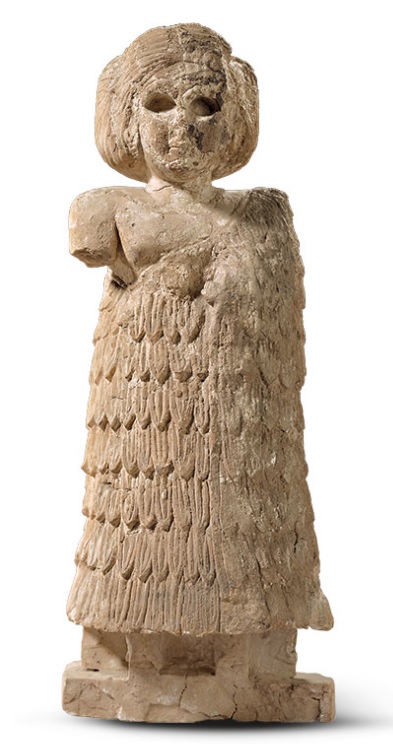
Standing female figure; Alabaster. Assur (modern Qal’at Sherqat), Ishtar Temple, level G, cella. Early Dynastic IIIb period, ca. 2400 BC.
© Staatliche Museen Zu Berlin, Vorderasiatisches Museum, Excavated 1913; VA 08144. Foto: Olaf M. Teßmer.
This statue once stood in the Ishtar Temple at Assur, the first Assyrian capital. The damage the figure has sustained since then reflects her history. Among other events, she witnessed the early days of Assur, the collapse of the Neo- Assyrian Empire in the seventh century BC, and the German excavations of the early twentieth century. While en route to Berlin during the First World War, this statue and other finds from Assur were confiscated by Portuguese forces and later exhibited in Lisbon, Portugal. They ultimately reached Berlin and were installed in the Pergamon Museum, where the statue survived heavy bombardments carried out by the Allied forces in the Second World War.
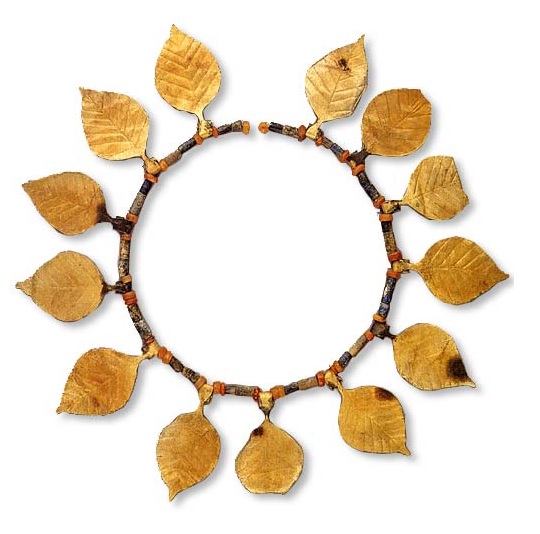
Wreath; Gold, lapis lazuli, and carnelian. Length: 40 cm
PG 800, Puabi’s death pit. Ur, ca. 2650–2550 B.C.
©University of Pennsylvania Museum of Archaeology and Anthropology
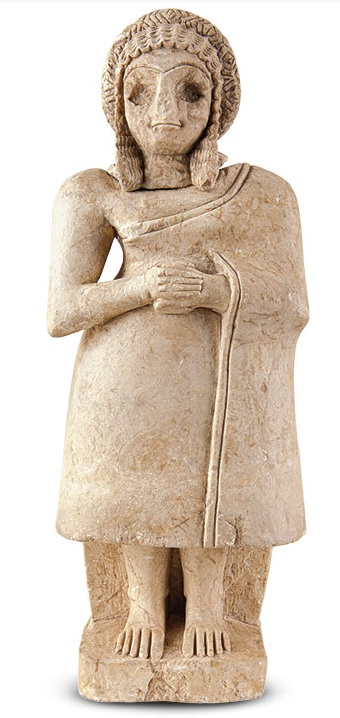
Standing female figure with clasped hands; Gypsum and shell. Sumerian, Tutub (modern Khafajah), “Sin” Temple IX. Early Dynastic IIIa period (2600–2450 BC)
© The Oriental Institute of the University of Chicago, A12412
The dress and hairstyle of this female figure are similar to those of several other statues included in this section. Her eyes and eyebrows are emphasized by their large proportions and now-missing inlays. Traces of paint indicate that her hair was once a dark color. The sculptor took great care with the soft carving of her cheeks, details of her lips and toenails, tightly arranged curls of her hair, and fold of her left clasped hand. Her skirt is slightly shorter than other examples, accentuating the figure’s unshod feet.
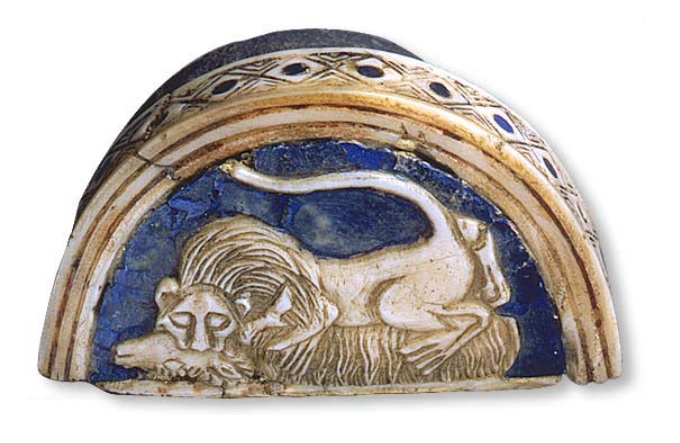
Cosmetic Box with Inlaid Lid; Silver, lapis lazuli, and shell. Height: 3.5 cm, Diameter across lid: 6.4 cm. PG 800, Puabi’s tomb; B16744a, b (U.10436). Ur, Iraq, ca. 2650–2550 B.C.
© University of Pennsylvania Museum of Archaeology and Anthropology
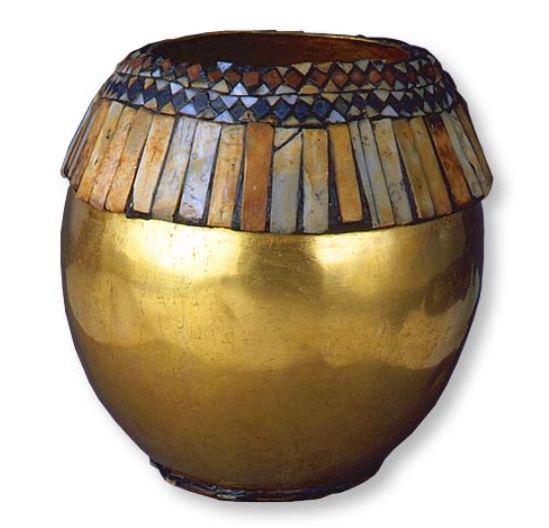
Gold Vessel in the Form of an Ostrich Egg
Ur, Iraq, ca. 2650–2550 B.C.
Gold, lapis lazuli, red limestone, shell, and bitumen
Height: 14.60 cm, Diameter: 13 cm
PG 779; B16692 (U.11154)
University of Pennsylvania Museum of Archaeology and Anthropology


المزيد عن فنون الرافدين في الصفحات التالية More about Mesopotamian arts on the following pages
 مركز دراسات الحضارة CCS